August 2024
Companies
Influence
Climate Policy
BY Bill Weihl
Welcome back to Connect the Dots, a newsletter from ClimateVoice focused on exploring the connection between companies, political influence, and U.S. climate policy. So far we’ve examined why policy is so important, the ways that companies engage (or, more often, sit on the sidelines), and the impact of trade associations in obstructing action.
This month we’re looking at the limitations of voluntary climate commitments by companies – particularly in light of the rise of AI – compared with public policy that sets market rules to drive decarbonization throughout the economy.
Over the past couple of years, the use of artificial intelligence (AI) has exploded, with people using it to do everything from writing wedding speeches to designing spaceship parts.
I know better than anyone how useful AI can be: since ALS left me unable to talk as of two years ago, a synthetic voice created using AI has allowed me to continue having conversations, even giving speeches on behalf of ClimateVoice, and keeping up the pressure on corporations to ramp up climate action.
But alongside the many valid concerns about this technology, from copyright infringement to future job security in a range of professions, is another major issue that we’re just beginning to understand: the massive amount of energy AI requires, where that energy is currently coming from, how tech companies are using this to justify rolling back their climate goals for their operations, and how their voices and influence could help enact public policy to drive systemic change.
Action Items
Find out whether your company is a member of the U.S. Chamber of Commerce, Business Roundtable, National Association of Manufacturers, or other trade associations actively working to obstruct climate action (especially if you’re a Tech employee). If so, gather your colleagues to urge your company to leave those groups.
Dig into our Employee Climate Action Guide and start asking questions at town halls or all-hands meetings (see step 2 in the Employee Climate Action Guide for inspiration).
Invite ClimateVoice to speak at your company to engage peers in a discussion on the role corporations can play in influencing policy.
Talk to your CSO and others on the sustainability team. Ask how they engage with policy, and what it would take for your company to use its influence more vocally.
Bonus – Sign and share the LEAD Statement, urging sustainability professionals to leverage their power and influence to accelerate climate policy progress.
The Big Picture
AI is Skyrocketing Big Tech’s Energy Use – and Making Companies Walk Back Climate Commitments
To me, the story of AI and climate is two-fold. First, AI could directly aid the fossil fuel industry; machine learning has already been used to identify where oil and gas deposits might be found. At a time when we need to keep all remaining fossil fuels in the ground to prevent the most catastrophic impacts of climate change, this is a dangerous use of this technology.
Second, the massive energy footprint that AI tools have incurred in the past few years has exposed the utter inadequacy of relying on voluntary individual – or even collective – corporate action without serious public policy to drive rapid systemic decarbonization.
Google provides a case in point: a recent Bloomberg News investigation found that thanks to the resources required to power AI, Google’s total greenhouse gas emissions in 2023 were 48% higher than 2019. During that period, the company’s total energy consumption doubled as it struggled to keep up with data center expansion. As a result, Google is unable to buy enough clean energy to power it all; the company no longer claims to be carbon-neutral (a win it has touted since 2007), and has pushed back its goal of net-zero emissions to 2030.
It’s a similar story for Microsoft, which has seen its emissions rise by 30% relative to 2020 primarily due to its AI activities. Microsoft still aims to be carbon-negative by 2030, and is betting on miracle solutions – such as the ever-elusive nuclear fusion – to make that possible.
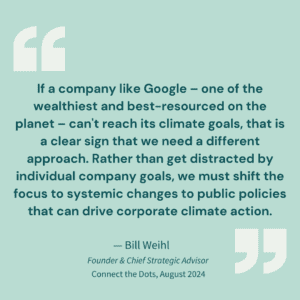
AI is driving up energy demand and creating a supply crunch for clean energy. If a company like Google – one of the wealthiest and best-resourced on the planet – can’t reach its climate goals, that is a clear sign that we need a different approach. Rather than get distracted by individual company goals, we must shift the focus to systemic changes to public policies that can drive corporate climate action.
Companies are currently trapped by their own goals and target dates. Take this hypothetical example of a company committed to 100% renewable energy: The company builds a new facility in a jurisdiction that has policies and plans (and is on target) for 100% renewable energy by 2030. However, the company already committed to use only renewable energy for all new facilities (and to backfill existing ones). So it negotiates power purchase agreements so it can claim the site is already 100% powered by renewable energy. This is a serious waste of time and energy – it gives the illusion of progress when the focus would be better placed on driving every grid on which they operate to shift to 100% clean energy quickly.
Like any technology, AI has good and bad uses, but companies simply cannot let its growing energy demands perpetuate fossil fuel production. This situation exposes how hard it is for individual companies, or even companies working together, to get to 100% clean energy through voluntary action.
Fortunately, we can solve this with public policy. Through actions like permitting reform, clean energy standards, and tax incentives, public policy can set the market rules that everyone operates under, helping rapidly expand clean energy infrastructure, stop the expansion of gas fired power generation, and start to replace existing fossil-fueled generation with clean power. With that underlying policy support, private action within those rules can drive rapid change at scale.
We’ve already seen some tech companies advocate for key policies. Salesforce and Microsoft publicly supported the Inflation Reduction Act (IRA), helping pass historic climate legislation in the U.S. in 2022. Similarly, in 2023 Adobe, Microsoft, Apple, Salesforce, and others supported the landmark California Climate Corporate Data Accountability Act (SB 253), ensuring greater accountability around climate disclosure.
There continue to be important opportunities for companies to use their influence at the local, state and federal level, including defending the IRA, supporting the EPA’s clean power plant rules, joining amicus briefs in support of the SEC’s national climate disclosure regulations, and supporting state and local policies focused on ratcheting up the standards for lower carbon buildings and transportation. It’s time for companies to speak up and help ensure that we have the market rules in place to drive a rapid and just transition to a zero-carbon economy.
The Nitty Gritty
We’ll use this section to wade deeper into top news in the climate world.
Ways to Make Your Company’s Voice Heard
- Continue to publicly support the Securities and Exchange Commission’s (SEC) final disclosure rules. Raise your support with your trade associations and industry groups, and reach out to your Members of Congress and convey its importance to level the playing field and provide business certainty. There is also an opportunity to engage with Ceres on an amicus brief supporting the SEC regulations.
- Amplify this issue by sharing ClimateVoice’s LinkedIn post and bringing it to your company’s attention by tagging your company’s leaders.
- Demonstrate real commitment to the collective action needed to achieve the just and equitable transition from fossil fuels agreed on at COP28 by ensuring your company signs the “Fossil to Clean” letter. We Mean Business has recently reopened the letter and is accepting new signatories. Your company should sign if it hasn’t already.
- Impress upon your Members of Congress the importance of the Inflation Reduction Act (IRA) to your business and the need to ensure full funding of its provisions and implementing agencies. If your company is in any way affected by the IRA, it should be speaking up publicly about its benefits and why we should protect it from rollback attempts.
- Show public support for the EPA’s recently finalized carbon standards for existing coal and new gas power plants. Considering that 25+ states have filed a lawsuit against the EPA along with several obstructive industry groups expressing intent to sue, there is a need for positive companies to underline the legality and benefits of the rules.
- Dig into the new Business Associations Climate Action Guide curated by the Net Zero Policy Community. This guide was launched to better inform businesses how to align their association memberships with positive climate policy engagement.
Resources to Learn More
- Tech companies aren’t the only ones rolling back climate commitments: Nike recently slashed its sustainability team after already missing its emission-reduction goals (the company has increased its emissions since 2015).
- In July, a shareholder resolution was filed at Microsoft to request that the company report on the risks of using AI to expand and optimize production of fossil fuels. For more on Microsoft’s climate goals, listen to this episode of the Bloomberg Zero podcast, where Brad Smith had this to say about Microsoft’s “moonshot” carbon negative goal: “The moon is now 5x farther away because of AI and the explosion in energy needed to build and maintain these systems.”
- Alongside its challenges buying enough clean energy to power its operations, Google recently stopped buying voluntary carbon offsets. This shift reflects a larger discussion currently happening about the efficacy of offsets, as the evidence grows that they don’t actually reduce emissions or scale well. Learn more about the issue in this in-depth Q&A from Carbon Brief.
- My latest Trellis Policy Voice column, as mentioned above, reviews the successes and impacts of voluntary corporate climate action, like power purchase agreements, and explains why public policy is needed as well.
For a Deeper Dive
How AI is Driving the Climate Crisis
- Direct use of AI in the oil and gas industry: Fossil fuel producers are a huge market for AI, and its use in that field is one of the few applications of AI at scale today. Making oil and gas AI tools is the only real short-term revenue generator companies like Microsoft may have for AI. Therefore, we expect these companies to double down on oil and gas partnerships.
- Energy use in data centers: There are currently about 11,000 data centers worldwide. We are seeing massive expansion of data center energy use globally, but especially in the U.S., where data centers are estimated to triple energy demand by 2030. This increase can’t all be attributed to AI, but an estimated 10-20% of data center energy in the U.S. is currently consumed by AI and that percentage will likely increase significantly going forward. Natural gas is being pushed as a quick option to support this energy demand; Goldman Sachs estimates that natural gas will provide an estimated 60% of new energy for data centers by 2030.
- Grid challenges: Modern life runs on energy, but to fight the climate crisis, it needs to be clean. The struggles Google and others are facing to find enough clean energy reveal the obstacles in cleaning up the grid: learn more about the limits of power purchase agreements, and how public policy can help, in my latest Trellis (formerly GreenBiz) Policy Voice column.
- AI as a climate solution: Although Big Tech likes to claim the potential of AI tools to solve problems, climate applications of AI today focus on forecasting, measurement, and optimization – all important, but not tackling the core problem of decarbonizing the global economy quickly. AI is certainly a useful tool for climate and other problems, but it is not a panacea – nor do we have to wait for AI (or some other breakthrough technology) to make rapid progress on decarbonizing.
Coming soon...
Stay tuned for our next issue where we’ll continue digging into corporate climate policy advocacy and the debut of our latest climate policy obstruction scorecard.
Have a specific question about Corporate Political Responsibility that you’d like us to address? Shoot your questions to us with subject line "Connect the Dots."
Have a specific question about Corporate Political Responsibility that you’d like us to address? Shoot your questions to us with subject line "Connect the Dots."