February 2025
Companies
Influence
Climate Policy
*Editors note: With so much at play at the Federal level right now, one might wonder why green teams at work are important. Drew’s piece reminds us that individual employees are critical in driving organizational change – and more than ever, we need courageous leadership at all levels now. If you’ve been on the sidelines, now is the time to speak up for clean energy and climate and sustainability commitments – and for protecting the places you love. Find your people and dig in!
Welcome back to Connect the Dots, a newsletter from ClimateVoice focused on exploring the connection between companies, political influence, and U.S. climate policy. So far we’ve examined why policy is so important, the ways that companies and employees engage (or, more often, sit on the sidelines), the impact of trade associations in obstructing action, and how sustainability professionals can be a powerful voice for climate policy.
In this issue, we’re exploring the recent first of its kind virtual webinar convened by ClimateVoice – Green Team Success Stories: How Employees Advance Climate Action at Work.
This cross-company session, led by Jennifer Allyn and Drew Wilkinson, provided an exclusive glimpse into how employees from Alphabet (Waymo), LinkedIn, Microsoft, Pinterest, and Salesforce have been self-organizing into large communities, often called Green Teams, for years. Employee efforts have shifted the dynamics of who can engage in sustainability work at these companies, created industry leading green innovations, and in each case, unlocked more resources and support for sustainability work. Read on to learn more!
I’m a climate activist, community organizer, and co-founder of Microsoft’s 10,000 member employee sustainability community. I left the company last year, but am on a mission to make sustainability part of everybody’s job. Partnering with ClimateVoice provides a unique opportunity to help employees understand how they can help their companies align their climate policy positions with their sustainability commitments.
Action Items
Watch the recording of Green Team Success Stories: How Employees Advance Climate Action at Work and get practical ideas on climate advocacy initiatives you could replicate in your workplace.
Join or create a Green Team! If you aren’t yet a member of your company’s Green Team or Employee Resource Group with a sustainability focus, join and volunteer to lead something. Start by looking around to see what groups already exist in your workplace, and if needed, find like-minded colleagues to start a group.
Learn more about climate policy advocacy and how to use your voice in service of what you care about. ClimateVoice’s toolkit, Climate Action at Work: A Guide for Employee Advocates, can help get initial ideas flowing around finding your influence, engaging your coworkers, and advocating for climate action.
The Big Picture
Employees Self-Organize to Create Meaningful Change
In December 2024, I helped ClimateVoice organize a webinar featuring employees from Alphabet (Waymo), LinkedIn, Microsoft, Pinterest, and Salesforce. They shared real-world examples of how their colleagues had self-organized into Green Teams to advance sustainability projects and initiatives, like divesting employee retirement funds from fossil fuels, scrutinizing corporate lobbying and trade association memberships, and bolstering the efforts of existing sustainability teams. They discussed employee engagement, highlighting the importance of making sustainability part of everybody’s job, and shared methods for encouraging colleagues to get involved, like hosting workshops, and leveraging internal communications channels. With a combined market value of $4.4 trillion at the time of writing this, employees from these five companies have successfully organized Green Teams comprising over 32,000 members, which represents an average of 11% of each company’s workforce!
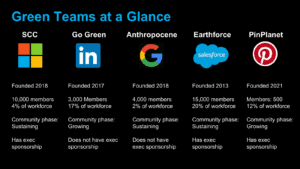
Graphic: Drew Wilkinson, 2024
A key focus was how to effectively organize and leverage existing internal Green Teams. The speakers provided practical strategies for community building, like fostering a genuine sense of belonging, hosting regular meetings, creating vibrant online discussion forums, and openly celebrating successes to maintain momentum. They also discussed common challenges in implementing employee-driven climate initiatives, such as management resistance and a lack of resources (volunteers, time, and budget), and offered solutions like building strong business cases for sustainability projects and securing executive sponsorship.
Read on to learn more about the individual company Green Team success stories that were shared and keep an eye out for ideas you can implement in your own organization.
The Nitty Gritty
We’ll use this section to wade deeper into top news in the climate world.
What is a Green Team and Why Do We Need Them?
Employee sustainability communities, oftentimes called Green Teams, can be defined as a group of employees within a company organized around the topic of sustainability. The community provides structure and support for all employees to get educated, inspired, and activated. They take many forms: some are Employee Resources Groups (ERGs), others are Communities of Practice (learn more about the difference here), but they largely play the same function: to make sustainability part of everybody’s job.
Even in the best-case scenarios, full time sustainability professionals often constitute less than 1% of an organization’s overall workforce, leaving these teams lacking resources and influence. Moreover, they are not well-equipped to assist the remaining 99% of employees with integrating sustainability into their daily tasks. Simply put, this model for embedding sustainability within organizations is not scalable. Green Teams are among the most scalable methods to increase sustainability work and use existing resources more efficiently!
- These groups work in organizations of all shapes and sizes and mostly run on volunteer labor, enabling individuals to align their passion and purpose with their work, while providing valuable career development opportunities and improving employee attraction and retention.
- Their decentralized structure breaks down organizational silos, fostering connection and collaboration across the entire workforce, while increasing overall climate literacy.
- These groups uniquely embed sustainability throughout every part of an organization, driving innovation while reducing environmental impact simultaneously. Most importantly, they transform sustainability from an operational task driven by a single team, to a core part of organizational culture, making sustainability part of everybody’s job in the process.
In short, they bring more helping hands to a problem that is larger than any one of us.
Alphabet, LinkedIn, Microsoft, Pinterest, and Salesforce are well-known leaders in corporate sustainability. However, the significant role their employees have played in encouraging and helping these companies to do more, primarily through Green Teams, is less recognized. This webinar provided an inside look at the efforts and strategies of these employees, offering a unique understanding of the common challenges and opportunities faced by those advocating for climate action within their workplaces.
Like all workplace communities, Green Teams generally follow a common maturity model. If you want to watch a short and humorous video that sums it up, be sure to check out Leadership From A Dancing Guy – it’s a classic!
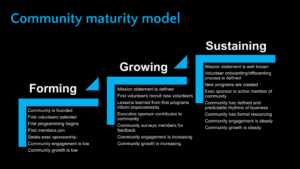
Graphic: Drew Wilkinson, 2024
There are typically 3 stages in a community like this: forming, growing, and sustaining, each a critical precursor for the following. As communities grow in size and complexity, if they are well managed and have the right cultural conditions around them, they mature, eventually becoming self-sustaining.
In the first phase, the community is forming! It is new, novel, has few members, low activity, and isn’t likely to be easily discoverable by all employees (potential members). In this phase, the community creates the place it will convene (usually an online community platform like Slack or Microsoft Teams), the first volunteers create the first community initiatives (monthly calls, newsletters, conversation forums, etc.), and ideally, are seeking top down support and sponsorship from an executive early. All good grassroots initiatives start small and the forming phase is an essential part of the community maturity process!
In the second phase, the community is growing! The mission statement (why does the community exist? For whom? How should they use it?) has been defined, the first wave of volunteers have launched the first wave of initiatives and programming and are now able to recruit additional volunteers to continue and expand this work, and these leadership teams are seeing increased membership and engagement from community members. Likewise, if they have secured executive sponsorship; this is a good time for the sponsor to play a visible and active role in the community, giving it legitimacy and support, which invites more employees to join and contribute! It can take years to go from forming to growing, so be patient!
In the final phase, the community is sustaining! Its mission statement is well known, it has a reputation across the company for being valuable, membership and engagement is growing and/or consistent without too much intervention, and volunteers have created rinse and repeat processes for the programs and initiatives the community runs (calls, events, learning libraries, etc.) AND for recruiting, onboarding, and offboarding volunteers. These gains of efficiency unlock a virtuous cycle for green teams: once the wheel is spinning, it’s easier to gain influence, support, and have higher levels of impact.
The employee stories you will read about below offer examples from various stages in this community maturity model – with each Green Team having grown beyond the ‘forming’ phase. For example, Go Green at LinkedIn, Anthropocene at Alphabet and PinPlanet at Pinterest are all in the ‘growing’ phase. Both Earthforce at Salesforce and Microsoft’s Sustainability Connected Community (SCC) are in the ‘sustaining’ phase.
Our webinar proved that these groups have the potential to go far beyond efforts such as office recycling and annual tree planting events. When employees organize for sustainability, they can gain power and influence, while securing more support for under-resourced sustainability professionals, and increase climate literacy across the workforce. In each case, the existence of an employee sustainability community caused these companies to do something they wouldn’t have done otherwise.
The speakers emphasized the importance of involving everyone in sustainability, shared real examples of successful employee-led climate initiatives, and provided practical tips for effectively organizing and leveraging Green Teams. They also provided a unique insight into the common challenges employees face when taking climate action: lack of top-down support, maintaining consistent programming with volunteers, obtaining resources, and how they have overcome these obstacles.
For a Deeper Dive
Green Team Success Stories Across Five Companies
Of the 5 companies we featured in this event, 3 can be classified as in the “Growing” Phase. Let’s take a closer look.
PinPlanet at Pinterest
Kevin Houldsworth is a Global Lead Client Partner at Pinterest and a sustainability advocate. He has driven numerous climate and sustainability initiatives at Pinterest and is the co-founder of PinPlanet, an employee community devoted to climate awareness and advocacy.
PinPlanet was launched in 2021 during an internal company hackathon. Kevin, inspired by the TEDxClimateActionTech video “No matter where we work, every job is a climate job now” from Jamie Alexander, which emphasized the responsibility of employees to promote sustainability within their companies, decided to take action. He reached out to Project Drawdown, where Jamie worked, and sought assistance in organizing an internal event to engage Pinterest employees in sustainability efforts. This initiative led to the creation of the PinPlanet community. Since then, the community has been dedicated to “evangelizing sustainability,” as Kevin describes it, across three main spheres of influence: employees, advertising partners, and Pinners (their users).
“Pinterest reaches half a billion people every month – we have an incredible opportunity to be a force for good and inspire Pinners with sustainability – that’s the area I’m most excited about!”
Pinterest, the smallest company represented at the webinar with just 4,000 employees compared to Microsoft’s 228,000, benefits from being small, nimble, and lean. This fosters a culture where employees feel empowered to take on tasks beyond their regular duties. Additionally, by aligning voluntary sustainability initiatives with the company’s existing priorities, such as emotional well-being, PinPlanet successfully overcame the resistance that many employees face when introducing sustainability efforts.
PinPlanet members have successfully made sustainability a higher priority inside the company, and are using their influence to advance sustainability with other key stakeholders, like customers and users.
Anthropocene at Alphabet (Waymo)
Sam Gooch is a Technical Program Manager at Waymo. Sam started his career in wind energy before working on electric vehicles at Apple and shared autonomous transportation at Waymo.
Formed in 2019 and featuring 3,000 members, Anthropocene is Google’s largest Green Team, though other employee groups are also advancing sustainability. Despite lacking executive sponsorship, the community has supported the development of major Google climate products through climate working groups and helped several hundred former Google employees, known as Xooglers, find climate education and volunteering opportunities in an era of mass layoffs.
In 2020, employees played a key role in Google’s industry-leading announcement to stop “building custom AI/ML algorithms to facilitate upstream extraction in the oil and gas industry.” Fellow tech workers at Amazon and Microsoft have tried for years to achieve similar results without success. Recently, Google employees like Sam Gooch have been working with the company’s HR and Benefits teams to advocate for a 401(k) retirement plan option that is divested from fossil fuels.
“Approximately 10% of most people’s 401(k) is invested in fossil fuel companies. We saw this as a perfect opportunity to better align with Google’s net zero commitments. As Vanguard’s [US’ largest 401(k) provider]’s largest client, Google has significant leverage.”
Sam and his colleagues provided educational opportunities to fellow employees and gathered more than 1,200 petition signatures. They initiated conversations with the sustainability team, and HR, building new relationships in the process. They have also spoken out about their campaign to build external support Google employees want to fight climate change via their 401(k)s. Discussions with the company are ongoing.
Go Green at LinkedIn
Prashansa Sonawane works with LinkedIn in Germany as a Senior Customer Success Manager. She co-leads the Go Green team within the LinkedIn Munich office and loves building initiatives for employees within the office to build awareness and take action towards climate change. As a Green Coach within LinkedIn, she is an advocate for developing green skills, finding green jobs, and empowering job seekers to build green skills.
Founded in 2017, LinkedIn’s employee sustainability community, Go Green, now has 3,000 members, representing about 17% of the workforce. As one of the company’s Employee Resource Groups (ERGs), Go Green provides opportunities for employees to engage in sustainability initiatives both at home and at work. Although the community lacks executive sponsorship, it receives internal support and is promoted on LinkedIn’s external pages 🌏 Around the World with LinkedIn’s Go Green Employee Group. 🌏
As a Green Coach, Prashansa collaborates with the company to enhance climate literacy among the workforce and help people acquire “green skills” that are in high demand but low in supply. LinkedIn produces best in class Green reports and resources including its recent Global Green Skills Report 2024, which highlights some of the green talent issues across industries.
“People are so surprised to learn that you don’t need a green qualification – which in many cases doesn’t exist – in order to find a green job.”
Prashansa encourages people to think broadly and consider ancillary jobs and industries beyond the obvious ones like renewable energy. April is a particularly busy time for Go Green, as Earth Month is the most impactful period of the year. This past year, Go Green leaders collectively organized over 60 events, both virtually and in physical offices, to engage employees in sustainability discussions and activities.
EarthForce at Salesforce
Céline Zollinger is the Director of Solution Engineering at Salesforce and a member of the Global Earthforce team, one of Salesforce’s 13 Equality Groups. Earthforce is dedicated to promoting and celebrating environmental responsibility both within the company and in the communities it serves.
Earthforce, the oldest and largest Green Team featured in the webinar, was established in 2013 and now boasts 15,000 members, representing nearly 20% of Salesforce’s workforce. Recognized as a Business Resource Group, it is one of 13 Equality Groups at the company, managed by the Office of Equality, which provides top-down structure and support. The community is organized into 31 geographical and regional “Hubs” around the world with volunteer leaders managing each. When asked what has contributed to Earthforce’s size, influence, and executive support, Celine mentioned 3 things: a company culture of philanthropy, the right organizational structure, and a commercial sustainability product, Salesforce’s Net Zero Cloud. Earthforce’s philosophy is to challenge each of their employees to think about how they, in their role, can become a sustainability advocate. They encourage this through asking oneself 3 questions: 1) What am I good at doing, 2) What brings me joy, and 3) What needs to get done. This helps employees think creatively about how they can contribute to the Earthforce community in any role and be a puzzle piece to drive impact within Earthforce.
The community enjoys robust top-down support and executive sponsorship, which is not common for all Green Teams. Earthforce collaborates with the company’s Chief Impact Officer, a Senior Vice President in the Energy and Utilities Industry, and an Executive Vice President of Customer Success and Partner Marketing. These executives leverage their networks and influence to support the community, mentor volunteer leaders, and consolidate global efforts into a few significant, achievable projects each year.
When asked about a project she was most excited about, Celine highlighted the Sustainability Storyteller’s Initiative. This project, which began in Earthforce’s UK Hub but has since spread, focuses on providing training to employees, which enables them to confidently discuss sustainability on behalf of the company with customers and other stakeholders. This initiative helps scale representation globally and gives local employees opportunities to represent the company at sustainability events, reducing air travel and emissions.
Earthforce members also use their volunteer hours for community work, such as planting trees, organizing clean-up days with local organizations, and removing invasive plant species in national parks. At work, they host educational workshops and learning events on topics like recycling methods, slow fashion, permaculture, carbon footprint calculation, plant based diets, solar lamp assembly, bird nest making, renewable energy, and more!
Overall, Earthforce is a large and well-established Green Team with robust top-down support and 15,000 members. Its size and influence enable it to direct members to opportunities that best match their interests and skills, ensuring there is no shortage of ways to get involved.
“One of our biggest successes has been having regional hub leaders who help simplify all employees in how to volunteer with earthforce and ensure we have a main champion month (1 month in the year) where the topic is fully dedicated to sustainability. This helps bring the theme to our company through internal communications throughout that month.”
Sustainability Connected Community at Microsoft
Van Riker has been a marketer at Microsoft for almost 10 years. He is the co-lead of an employee-based campaign to pressure Microsoft to leave the U.S. Chamber of Commerce. Additionally, Van recently became the Engagement Lead for Microsoft’s green team.
Holly Alpine is a seasoned leader in sustainability with over a decade of experience driving global environmental initiatives, including founding Microsoft’s Community Environmental Sustainability program and co-leading its Employee Engagement program for sustainability. Now leading a public campaign for stronger environmental accountability in the tech industry, she also serves on the boards of American Forests and Zero Waste Washington, while pursuing her passions as an avid plant-based athlete.
Established in 2018, Microsoft’s Sustainability Connected Community (SCC) was arguably the most influential Green Team represented on the call. It features 10,000 members across nearly 40 regional chapters, enjoys executive sponsorship from the Chief Sustainability Officer, and is highlighted annually in the company’s external-facing sustainability reports. The speakers provided compelling examples of how employee efforts to change the way the company works with fossil fuel companies and corporate trade associations had changed because of employee efforts.
Learn more about the community on pages 9-10 of Microsoft’s 2021 Environmental Sustainability Report | Microsoft CSR.
When asked about the origin of the community, SCC co-founder Holly Alpine said the SCC was “born out of necessity – so employees could see what they wanted at Microsoft.” The community’s mission is to make sustainability part of everybody’s job. Day to day community operations rely on a network of global volunteers who spend a few hours a week running programs that keep the entire workforce educated, inspired, and activated. Community members are encouraged to ask questions, provide answers, and share resources freely in this Community of Practice, creating an environment where information and opportunities abound. Learn more about the SCC here how to build your own employee sustainability community.
The SCC plays an important role holding the company accountable to its sustainability commitments and pushing it to go further. For example, community members have raised concerns internally for years about how Microsoft provides advanced technology, including AI, to the fossil fuel industry to dramatically increase production – producing additional emissions that far exceed Microsoft’s corporate emissions, including datacenters. These concerns ultimately led to a dialogue between employees and the company’s President, and the publication of Microsoft’s first ever energy principles, which place conditions on how the company engages with the fossil fuel industry. Employees at all companies have a critical role to play in pushing their employers to be more sustainable; the more organized they are, the more effective they will be.
Learn more: Microsoft employees spent years fighting the tech giant’s oil ties. Now, they’re speaking out. | Grist
Alpine ultimately quit the company in January 2024, partially in protest at the lack of progress on this issue, but primarily to add external pressure to complement ongoing employee initiatives.
Learn more: I loved my job at Microsoft, but I had to resign on principle. Here’s why | Fortune
Recently, the community has focused on the influence of corporate lobbying and trade associations in shaping climate policy. ClimateVoice has been vocal about the U.S. Chamber of Commerce’s obstruction of climate policies.
Van Riker worked with colleagues for more than a year to highlight the discrepancy between the U.S. Chamber of Commerce’s actions and Microsoft’s sustainability policy positions as a dues-paying member. The Escape the Chamber campaign provided educational opportunities for SCC members to learn about the role of corporate lobbying and trade associations in climate policy. They translated this awareness into action, creating a petition asking Microsoft to provide more transparency into its trade association memberships and climate policy positions, and asking the company to leave the Chamber over its climate policy misalignment.
The effort paid off. In January 2024, Microsoft released a report titled “Sustainability Policy Alignment, US Trade Associations,” offering an unprecedented overview of the positions on eleven key climate policies held by eight trade associations involved in US federal climate policy, compared to Microsoft’s. Unsurprisingly, there was a lot of misalignment.
The company stated, “As we make progress toward sustainability commitments, we also evaluate how our climate goals align with the advocacy efforts of the trade associations we are members of,” and pledged, “where there is misalignment, we will redouble efforts to engage with the trade association to drive closer alignment in their advocacy for a more sustainable future.” The company has not done anything else on the issue yet, and employee efforts continue. Learn more about the Escape the Chamber campaign at Microsoft.
Overall, the SCC is an influential and highly active Green Team with a proven track record of success. They have effectively encouraged Microsoft to not only enhance sustainability within its own operations but to also consider the broader impact of its technology and influence on customers, partners, and the planet itself.
“We want to make people aware of what the Chamber is doing to obstruct climate policy, how they are completely misaligned with Microsoft’s values as a corporation and get Microsoft to lead in the sustainability space.”
In Closing…
Employees have a critical role to play in ensuring businesses do their part to address climate change. After all, the key word in “business as usual” is business. From getting companies to make science based commitments to reduce their emissions, waste, and water, to ensuring they consider the FULL scope of their environmental impact including their products, partnership, and procurement practices, investments and financing, and of course – climate policy advocacy, Green Teams have tremendous opportunity to accelerate the scope of pace of sustainable change inside any organization.
We learned that the challenges employees face doing this work are more similar than different: lack of place (no sustainability community), lack of time (burnout, layoffs, and competing priorities), lack of influence (employees are not considered a critical stakeholder), lack of knowledge (little to no climate literacy in the workforce), and crucially, lack of support (no top down sponsorship from a Chief Sustainability Officer or executive).
The good news is that all of these obstacles can be overcome, and the employees in Green Team Success Stories: How Employees Advance Climate Action at Work told us how each had uniquely done it in their organizations.
Their most important advice? Be persistent! It takes time to gain influence with decision makers in a company, build community, and advance climate literacy, especially when using volunteers! But speaker after speaker showed us examples of how employees leveraged green teams to advance climate action at work! You, and your colleagues, can too! Hopefully these resources help you take the first steps.
Remember: to change everything, we need everyone.

Graphic: Flickr, Melbourne Global Climate Strike September 20, 2019
| The opinions and views expressed in this interview are solely those of the individual(s) being interviewed. They may not reflect the views, policies, or positions of ClimateVoice, the employer(s) of the individual(s) being interviewed, nor of any other organizations with which the individual(s) being interviewed are affiliated. This interview is intended for informational purposes only and should not be interpreted as an endorsement or official statement on behalf of such employer(s) or organization(s). All logos as well as company, product, and program names are registered servicemarks and/or trademarks owned by the respective companies. No affiliation or endorsement between these companies and ClimateVoice is implied. |
Coming soon...
Stay tuned for our next issue where we’ll continue digging into corporate climate policy advocacy and how companies can lead the charge at the state level.
Have a specific question about Corporate Political Responsibility that you’d like us to address? Shoot your questions to us with subject line "Connect the Dots."
Have a specific question about Corporate Political Responsibility that you’d like us to address? Shoot your questions to us with subject line "Connect the Dots."