February 2026
Companies
Influence
Climate Policy
Welcome back to Connect the Dots, a newsletter from ClimateVoice focused on exploring the connection between companies, influence, and climate policy in the United States.
The guest editor for this issue is our very own Campaigns and Program Director Jennifer Allyn. Six years ago, Jennifer left her role leading diversity strategy at PwC to join ClimateVoice. Officially, she’s responsible for designing our campaigns and mobilizing employees to advocate for climate solutions at work. Unofficially, she’s also our book scout, who reviews the latest titles on behalf of our team. Recently, she’s been on a roll reading about the attention crisis and worrying about how our lack of collective attention impacts the climate crisis.
In this issue, we’ll examine what attention is, why it’s so valuable, and how powerful forces are deliberately distracting us. She will also direct your attention to a meaningful climate solution you can focus on right now.
Have you ever left your house without your phone and felt panicked like you were missing a limb? Or lost countless hours in a day from compulsively checking social media? Or felt completely overwhelmed by the news before you even got out of bed?
I have. And it feels terrible! During the pandemic I noticed a significant decline in my ability to focus. I would reach for my phone the moment I woke up and anxiously doomscroll all day. For the first time in my life I had trouble finishing a novel, even though reading is my favorite pastime. So I started experimenting with strategies to restore my attention.
I practiced meditation, first online, and then in person at a Buddhist center in my neighborhood. I silenced notifications on my phone, deleted apps, and limited my screen time. Then last January I decided to follow author Sebene Selassie’s rule: “No News Before Noon.” It has been transformative to start each morning focused on my own priorities, instead of having my attention immediately hijacked by negative headlines. I still stay informed and the news is still overwhelming, but I feel more equipped to face the day’s tragedies after having some protected time.
I’m happy to report these practices really helped. I’m reading deeply again and hope you enjoy the many book recommendations in this issue!
Action Items
Learn about attention by reading these fascinating books: Attensity! A Manifesto of the Attention Liberation Movement by the Friends of Attention, Stolen Focus by Johann Hari, The Siren’s Call: How Attention Became the World’s Most Endangered Resource by Chris Hayes, and How to Do Nothing by Jenny Odell.
Practice mindfulness. Limiting screentime is a great place to start, but any activity can deepen your attention if it’s done intentionally. Cooking food, making music, or playing sports would all count as long as you’re not multitasking. The purpose of the exercise is to slow down and become more aware of the present moment.
Keep your focus on climate policy solutions. One literal bright spot right now is the exciting momentum of the growing ‘plug-in solar’ movement (also known as balcony solar). Join us in advocating for a state level climate policy to democratize solar energy and urge your company to do the same.
The Big Picture
What Is Attention and Why Does It Matter?
When we talk about attention we usually mean that quality of single-mindedness where we can shut out competing thoughts. Scholars commonly use the metaphor of a spotlight to illustrate singular focus. The ability to direct our mind is most associated with productivity, but it turns out that mind-wandering is also an important feature of awareness that is critical for creative thought. The most pleasurable form of attention is when we achieve “flow,” a sense of feeling so completely absorbed in an activity that we don’t even notice the passing of time.
Collective attention is our shared experience of focusing on issues or events with other people. In politics, we need collective attention to decide which societal problems are even worth attending to at all. Then we need sustained focus to figure out how to solve them together.
Much of the public debate about attention is narrowly focused on improving concentration, but in The Siren’s Call Chris Hayes explains why the stakes are actually much higher.
“Attention is the substance of life. Every moment we are awake we are paying attention to something, whether through our affirmative choice or because something or someone has compelled it. Ultimately, these instants of attention accrue into a life.” (p.3)
He argues that attention is incredibly valuable because it is scarce. We may try our best to pay attention to multiple things at the same time, but it turns out that multitasking is a myth. Our brains still need to refocus after switching between tasks and devices. While corporations have always sought to capture our attention for profit, the volume of information vying for our limited attention has dramatically increased over time.
The Nitty Gritty
We’ll use this section to wade deeper into top news in the climate world.
How Does the Attention Crisis Relate to the Climate Crisis?
Johann Hari is credited with coining the term “attention crisis” in his book Stolen Focus. He explains how digital platforms are designed to be addictive, and actually use the same techniques as slot machines to keep us glued to our screens. Because outrage fuels engagement, social media platforms feed us customized, negative content which exacerbates political polarization. Many people feel ashamed of their inability to stop scrolling, but Hari reframes the problem. Instead of viewing chronic distraction as an individual failure, he sees it as a collective challenge preventing us from solving urgent issues like climate change.
“We need to rapidly transition away from fossil fuels and toward powering our societies by clean, green sources of energy . . . These solutions are not going to be achieved by an addled population who are switching tasks every three minutes and screaming at each other all the time in algorithm-pumped fury. We can only solve the climate crisis if we solve the attention crisis.” (p. 282)
The founders of the School of Radical Attention agree with Hari that attention is inherently political and must be fought for collectively. Attensity! is a manifesto calling for a new movement of attentional activism to resist “human fracking,” which the authors explicitly link to pollution.
“Petroleum fracking is doing irreversible damage to our external environment (our woods and fields, our water and sky) while the human frackers are verifiably destroying our interior environment (our minds and hearts, our ability to be and to sit with ourselves and the people we love).” (p. 35).
The school is not against technology, but their mission is to push back against the trillion-dollar industry that is extracting our attention at scale. They argue that corporations are causing untold damage by treating both human consciousness and the planet as resources to be endlessly mined.
And the situation is getting worse. AI is escalating the war for attention and driving enormous demand for electricity to power the technology. Tech companies are in a race to build new data centers, which are predicted to emit staggering amounts of carbon into the atmosphere. As a result, we can no longer ignore how the attention economy is directly related to global warming.
For a Deeper Dive
What Deserves Our Attention?
At this point you may be asking yourself, “how can I possibly pay attention to the climate crisis when democracy and the rule of law are under threat in the United States?” It’s an important question that even climate journalists are asking themselves. After personally grappling with this issue, Emily Atkin makes a persuasive case in HEATED that the forces undermining democracy are also destroying the planet. She outlines multiple ways fossil fuel companies enable authoritarianism for example, through political donations, lobbying, and supporting laws to penalize protestors. Then she concludes that it’s actually our obligation to pay attention to how these systems are interrelated.
Now that’s a powerful example of connecting the dots!
What we know for sure is that 2026 will be unpredictable. Our individual and collective attention will be pulled in directions we can’t yet even imagine. That is why the ClimateVoice team is laser focused on finding promising climate policies you can advocate for right now.
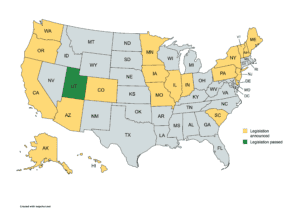
In that spirit, we want to make you aware of plug-in solar, which are small, affordable panels that anyone with outdoor space can simply plug-in and use to generate electricity. These units are already popular with over 4 million European households using balcony solar to save money on their electric bills. But U.S. regulations were designed for rooftop solar and make this technology illegal in 49 states. The exception is Utah, which just last year unanimously passed a law to enable plug-in solar.
Source: Bright Saver
Right now 21 states, both red and blue, are following Utah’s lead by introducing state bills in this legislative cycle. As a New Yorker, I was excited to attend a press conference for the SUNNY Act (Solar Up Now New York) and to ask my state senator to support it. As we highlighted in our recent action alert:
- If you are in one of the states with an active bill, contact your state legislators and let them know you support plug-in solar as a way to make clean energy more accessible and affordable.
- If your state is not on this list, ask your representative to sponsor a bill.
- Elevate this climate policy advocacy opportunity within your own company and urge your sustainability and/or government relations teams to weigh in with public support at the state level, everywhere your company operates.
Plug-in solar might seem like a small idea at first, but it has the potential to expand access to renewable energy to 60 million Americans without involving the federal government. Passing this legislation in just 5 states will create a multiplier effect where consumer demand increases the supply of these panels, drives down costs and makes solar mainstream.
Collective attention is vital to turn ideas into reality. Help us raise the visibility of plug-in solar and together we can spark a movement for energy that is abundant, affordable, and clean.
Coming soon...
Stay tuned for our next issue where we’ll continue digging into corporate climate policy advocacy and how companies and employees can raise the bar on what corporate climate leadership looks like, especially during these uncertain times.
Have a specific question about Corporate Political Responsibility that you’d like us to address? Shoot your questions to us with subject line "Connect the Dots."
Have a specific question about Corporate Political Responsibility that you’d like us to address? Shoot your questions to us with subject line "Connect the Dots."