November 2025
Companies
Influence
Climate Policy
Welcome back to Connect the Dots, a newsletter from ClimateVoice focused on exploring the connection between companies, political influence, and U.S. climate policy. In recent editions, we’ve examined why policy is so important, the ways that companies engage (or, more often, sit on the sidelines), the impact of trade associations in obstructing action, and how sustainability professionals can be a powerful voice for climate policy.
In this issue, we’ll be exploring how many U.S. companies are choosing the wrong side of history in the face of climate denialism and full-throttle obstructionism when it comes to enabling the clean (and cheaper) renewable energy transition. We’ll consider what we can do in response, drawing on lessons from successful social movements – including examples underway this year.
Action Items
Build up your personal advocacy muscles. Check out ClimateVoice’s Climate Action Checklist for actionable steps you can take to advocate for climate action at work. Find advice, best practices, education, ideas, inspiration, and resources you need to get started.
Advocate for your company to be on the right side of history when it comes to climate and clean energy. Reach out to your company’s leaders and share your concerns.
The Big Picture
Too Many U.S. Companies are Choosing the Wrong Side of History (Especially Big Oil + Big Tech)
Climate action and the clean energy transition have taken big hits in 2025 – coupled with democratic backsliding and rising corporate political spending in the U.S. The oil and gas agenda (coupled with outright climate denialism) dominates U.S. politics, with fossil fuel interests pouring a historic $96 million into President Trump’s campaign and affiliated political action committees. The oil and gas industry continues to perpetuate climate disinformation, manufacturing doubt about climate science, greenwashing, and engaging in decades of deliberate disinformation campaigns aimed at thwarting climate action. Tech companies are failing to stop disinformation – even giving up on efforts to combat misinformation online.
And when it comes to corporate political advocacy: large U.S. companies continue to overwhelmingly lobby to obstruct climate policy progress, falling in line with fossil fuel industry counterparts and increasingly choosing silence, greenwashing and greenhushing rather than meaningful advocacy for climate and clean energy. This coupled with the trajectory to accelerate resource-intensive AI and the data center boom brings with it a plethora of adverse environmental risks and community impacts with water usage, electricity demand, and the associated pollution and rising carbon emissions at the top of the list.
Companies once seen as allies and leaders in the corporate social responsibility space are now faced with daily ethical dilemmas, largely remaining silent in the face of ongoing anti-climate efforts by the current administration to cut federal climate science research, claw back the Inflation Reduction Act’s clean energy provisions, and repeal dozens of regulations that aim to keep America’s water and air pollution at bay. And when it comes to companies undermining democracy and democratic norms, companies such as Amazon and Meta now top the list of the 2025 Corporate Underminers of Democracy Report published by the International Trade Union Confederation – along with Northruop Grumman, Palantir, and Vanguard.
Eight years ago, companies like Amazon, Apple, Google, Meta, and Microsoft were vocal in their criticism of President Trump’s first exit from the Paris Climate Agreement. Now, these very same companies are financing the recent demolition of the East Wing of the White House for a new ballroom, raising ethics and transparency concerns in what appears to be a bid to gain access and influence policy decisions. The move also demonstrates a stunning show of support for an administration that is under scrutiny for democratic backsliding and a breakdown in respect for the rule of law.
Meanwhile, many of these same companies are not only failing to deliver on prior emissions reductions and climate goals, but are also actively enabling accelerated fossil fuel production through partnerships such as between Google and Aramco and Microsoft’s ‘enabled emissions’ where its AI plays a key role in helping oil companies to increase fossil fuel expansion.
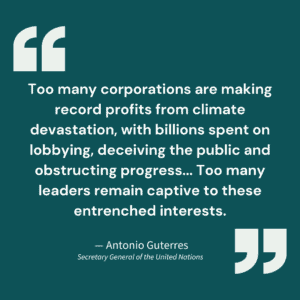
Furthermore, thousands of oil, gas and coal lobbyists continue to gain unprecedented access to the Conference of Parties (COPs), blocking urgent climate action. In his speech at COP30 in Belem, Brazil, Secretary General of the United Nations Antonio Guterres noted: “Too many corporations are making record profits from climate devastation, with billions spent on lobbying, deceiving the public and obstructing progress… Too many leaders remain captive to these entrenched interests.”
With so many companies choosing the wrong side of history when it comes to climate and clean energy advocacy, information integrity, and democratic backsliding – you may be (like me) faced with rising concern for the future – wondering: where do we go from here? The good news is there is always the opportunity to flex our advocacy muscles and there has never been a better time to do so.
Wherever you work, it’s time to roll up your sleeves, fasten your seatbelt, and get serious about advocating for change.
The Nitty Gritty
Social Movements – Including Inside and Outside Pressure – Contain the Ingredients that Lead to Change
Presently, both the climate and corporate political and social responsibility movements are at an inflection point. Many are backsliding (take the examples shared above, or Bill Gates and his recent comments on the climate crisis as in-the-moment examples). In a moment when corporate and political power structures are sending us in the wrong direction, it’s time to turn to lessons from successful social movements of the past for guidance.
What has previously worked to effect change and move systems and societies to the right side of history? Whether it be the famous bus boycotts, sit-ins, or Freedom Rides during the Civil Rights Movement, the conventions, peaceful protests, and letter-writing campaigns of the Women’s Suffrage Movement, or the sugar boycotts used by abolitionists in Britain to pressure the government to end slavery – the arc of impacting systemic change reflects a variety of creative actions including coalition building, cultivating strong relationships across networks and geographies, coupled with coordinated communications and advocacy efforts. Labor unions have also forced positive change through strikes, walk-outs, and collective bargaining, which led to worker protections, child labor, and minimum wage laws and the 40-hour workweek, to name a few key victories. There is also a combination of both inside (internal pressure from within organizations) and outside (public) pressure needed to spur decision makers to act – forcing a moral and ethical dilemma demanding responsive action.
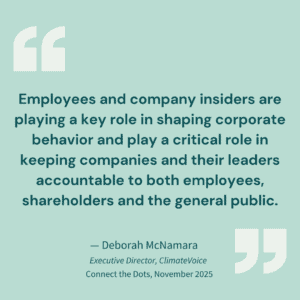
Social change efforts are already underway and visible in 2025, especially when it comes to companies and their social and political footprints. Employees and company insiders are playing a key role in shaping corporate behavior and play a critical role in keeping companies and their leaders accountable to both employees, shareholders and the general public.
Earlier this year, Walmart employees pressed CEO Doug McMillon to stand up to the administration’s diversity, equity, and inclusion rollbacks. In October, Salesforce CEO Marc Benioff called for the National Guard in San Francisco, and had offered its services to help ICE, and was immediately greeted with a Board resignation and a mass letter of protest from current and former Salesforce employees – leading to a public apology from Benioff. In September, tech workers at Microsoft refused to build surveillance tools, protesting the use of Azure cloud and AI technology by Israel’s military for mass surveillance of Palestinians. Employee advocacy on the issue led to Microsoft halting a major contract with the Israeli military – confirming its technology is not to be used for mass surveillance of civilians.
Meanwhile, the climate movement and labor movement are finding one another in 2025 in collaborations, such as through the Labor Network for Sustainability (focused on ‘everyone being able to make a living on a living planet’), and the new Wells Fargo Workers United Union – formed in the aftermath of Wells Fargo dropping its 2030 and 2050 climate goals. This is the first time a union is forming at a U.S. bank this large – with 28 Wells Fargo branches having voted to unionize and actively engaging in bargaining this fall.
The majority of employees – nearly two-thirds according to Deloitte’s latest research – say their employers are not doing enough to address climate change and sustainability, with a growing number of employees pushing their companies to do more. The movement to press companies for climate-friendly 401(k) options has gained momentum, with employees raising questions as to why continued investments in fossil fuels are the norm (even when fossil fuels are among the S&P 500’s worst-performing sectors). Internal employee advocacy at Google led to the decision to add a more climate-friendly fund to its 401(k) plan this year. Employees at other companies such as Apple are currently advocating internally for climate-safe retirement plans as well.
As we head into 2026 and continue our collective work in urging companies to be on the right side of history when it comes to climate and clean energy, let’s continue to build networks and advocacy opportunities focused on calling for community, environmental, and workplace protections – key ingredients for a healthy and thriving society for all.
For a Deeper Dive
Companies Will Face New Risks and Opportunities as Employees, Investors, Shareholders, and Communities Respond
Despite the headwinds, some companies are doubling down on their commitments and moving full steam ahead with ushering in a new era that is responsive to both people and the planet. The B Corp movement stands out as a key example this year – with efforts underway to integrate policy advocacy as a critical component of B Corp Certification. These companies recognize that as corporate influence in politics grows, so does public scrutiny. The new standards acknowledge this business influence and require companies, especially larger global corporations, to have a public policy on responsible lobbying.
Companies will indeed face new risks and opportunities as employees, investors, shareholders, and communities respond. The World Business Council for Sustainable Development’s (WBCSD) Business Breakthrough Barometer report notes that 61% of business leaders predict that increased costs from climate-related disruptions will impact their business, and nine out of ten businesses say they will maintain or increase their transition-related investments and emissions targets. Holding companies accountable to these commitments will be essential in 2026 and beyond.
Climate-related financial risk isn’t the only dilemma facing U.S. businesses today. There is also the growing risk of consumer boycotts, which companies are increasingly compelled to disclose in their annual regulatory filings. This year, Amazon, Disney, Home Depot, Target, and Walmart join an increasing number of companies who may feel pressure to inform investors about consumer backlash from rolling back diversity, equity, inclusion (DEI) policies, environmental, social, and governance (ESG) or climate initiatives, free speech complaints, and more. Earlier this year, the Commons app (which has some 500,000 users) urged members to “vote with their dollars,” demanding companies use their influence to lobby and advocate for climate policy. Boycotted companies included Amazon, Home Dept, Lowe’s, Walmart, and many others.
The impacts of mounting boycotts? Target’s stock has plummeted 33% since the rollback of DEI initiatives and the launch of the boycotts, eliminating over $20 billion in shareholder value as of September of this year. Starbucks has also faced a series of consumer boycotts over a number of issues and has seen six straight quarters of declining sales in the U.S., resulting in a recent announcement that it would be closing 1% of its North American stores by the end of 2025 and raising concerns that the closures signify a shift in consumer values.
How will companies continue to respond to the many existential threats of our times? And which ones will be remembered for being on the right side of history? Business leaders do well to remember their commitments to shareholders, employees, customers, and American communities. The realities of climate change – and the associated risks – will not be going away. As we’ve written before: Silence will not lead us to a better future. Practicing corporate political responsibility and moral courage will, if we act now.
Coming soon...
Stay tuned for our next issue where we’ll continue digging into corporate climate policy advocacy and how companies and employees can raise the bar on what corporate climate leadership looks like, especially during these uncertain times.
Have a specific question about Corporate Political Responsibility that you’d like us to address? Shoot your questions to us with subject line "Connect the Dots."
Have a specific question about Corporate Political Responsibility that you’d like us to address? Shoot your questions to us with subject line "Connect the Dots."