Policy Brief(ly):
This brief explains why plug-in solar is an innovative state policy worth supporting. Help raise the visibility of this climate solution inside your company to spark a movement for energy that is abundant, affordable, and clean.
Plug-in solar can be as easy as plugging into an outlet — but only if state law allows it.
- Solar United Neighbors
Key Takeaways
- Climate policies are moving forward at the state level and provide a key advocacy opportunity for employees and business leaders.
- In 2025, Utah passed a first-of-its-kind bipartisan bill to enable plug-in solar, which are small, affordable panels that anyone with outdoor space can plug-in and use to generate electricity.
- 20+ states are following Utah’s lead by introducing bills in 2026, providing an important opportunity that will address energy affordability concerns, while also expanding clean energy and reducing greenhouse gas emissions.
- Take action by supporting this legislation and by asking your company to do the same.
The Challenge
Despite attacks on renewable energy at the federal level, wind and solar are the least expensive and most scalable power source. Expanding access to solar energy in the United States has the potential to address the climate crisis at scale by reducing emissions while also tackling the affordability crisis by expanding access and promoting energy security.
As electricity costs keep rising across the U.S., one in six households struggle to pay for power. Solar is now the cheapest source of energy, but millions of Americans can’t access this renewable resource. According to a National Renewable Energy Laboratory report, “approximately 70% of Americans are effectively shut out of the rooftop solar market” because they are homeowners who can’t afford the high upfront cost of installing solar or they are renters who don’t own their roofs. In addition, not all roofs can accommodate solar panels.
A Policy Solution
Bright Saver is a nonprofit organization dedicated to democratizing solar power in the United States by promoting plug-in solar. In contrast to rooftop solar, these modular units are small (≤1200W) and plug into a standard outlet. They can be mounted in any sunny spot on the ground, against a wall or on a terrace. These panels are already popular in Europe, where they are called “balcony solar.” In fact, over 4 million European households are currently saving money on their electric bills with this technology.
The problem is that current U.S. regulations were designed for large photovoltaic systems, which make widespread adoption of plug-in solar nearly impossible, and technically illegal, in 49 states. The exception is Utah, which unanimously passed a law (H.B. 340) in 2025 to exempt plug-in solar from burdensome interconnection rules and net metering agreements. This regulatory reform was budget-neutral and bipartisan. Describing why he sponsored the bill, Utah Representative Raymond Ward, said:
“There shouldn’t be any more red tape to purchase one of these than to purchase a hair dryer or space heater. The experience in Europe has shown that these are safe products for everyday consumer use and it is time for us to get our regulations here in the United States updated to reflect that.”
– Utah Representative Raymond Ward on why he sponsored plug-in solar legislation in 2025
Plug-in solar might seem like a small idea at first, but it has the potential to expand access to renewable energy to 60 million Americans without involving the federal government. Bright Saver estimates that removing the red tape to pass this legislation in just 5 states will create a multiplier effect where consumer demand increases the supply of these panels, drives down costs, and makes solar mainstream.
The Advocacy Opportunity
Bright Saver acts like a matchmaker introducing Utah’s model bill to lawmakers in other states and encouraging legislators to sponsor legislation across party lines. The good news is that this issue resonates across the political spectrum and might be the brightest bipartisan spot in climate policy!
83% of voters in 5 states say solar energy should be used to strengthen and increase the U.S. energy supply.
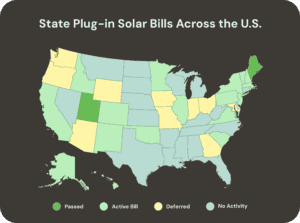
State data provided by Bright Saver. Current as of 4/8/2026.
Calls to Action
Advocate Individually: If you are in one of the states with active legislation, contact your state legislators (you can find them using the elected officials database) and let them know you support plug-in solar as a way to make clean energy more accessible and affordable. Use our email template included in the section below for talking points.
Sample Email – Contact Your State Legislators
Dear [Senator / Representative ____],
I am one of your constituents from [your city, state]. I'm reaching out to ask you to support [name of plug-in solar bill in your state] to expand access to clean energy. Last year, Utah lawmakers unanimously passed a first of its kind bill to enable plug-in solar in the U.S. These systems not only help cut electricity costs but also reduce greenhouse gas emissions and pollution. Thank you in advance for endorsing this legislation and helping solar energy go mainstream.
Sincerely, [Your name]
Leverage Corporate Influence + Invite Your Colleagues to Join: Elevate this climate policy advocacy opportunity within your own company and urge your sustainability and/or government relations teams to weigh in with public support at the state level, everywhere your company operates. Urge your company to be a clean energy leader and to proactively advocate for clean energy at both the state and national level.
Sample Social Post – Ask Your Company
Solar energy is now the cheapest source of power on the planet, but millions of Americans can’t access clean energy because of burdensome regulations. We can change that by supporting [name of plug-in solar bill in your state].
I’m proud that my company has renewable energy goals and is part of the solution. Let’s all use our influence as citizens, consumers, and employees to spread the word about this important legislation. [tag your company and colleagues].
Additional Resources
- Visit Brightsaver.org to learn more about plug-in solar and how to support the movement to expand solar energy in the U.S.
- Use this Solar Advocate Citizen Lobbying Guide from Solar United Neighbors to influence energy policy in your state.
- Check out ClimateVoice’s Climate Action Checklist for steps you can take to advocate for climate policy progress at work. Find advice, best practices, education, ideas and resources that you need to get started.