April 2026
Companies
Influence
Climate Policy
Welcome back to Connect the Dots, a newsletter from ClimateVoice focused on exploring the connection between companies, influence, and climate policy in the United States. In recent editions, we’ve examined why policy is so important, the ways that companies engage (or, more often, sit on the sidelines), how the attention crisis fuels the climate crisis, and how companies can get on the right side of history when it comes to climate action.
In this issue, we’ll be exploring how climate policies are moving forward at the state level, and spotlighting policy advocacy opportunities underway for employees, sustainability professionals and business leaders. With the absence of government leadership at the national level, there’s even more of an imperative for businesses to act.
Action Items
Read ClimateVoice’s Issue + Action Policy Brief highlighting why plug-in solar is an innovative state policy worth supporting.
Join us in advocating for state level climate policies such as plug-in solar to democratize solar energy and urge your company to do the same. With bills underway in 25+ states, help raise the visibility of this climate solution to spark a movement for energy that is abundant, affordable, and clean.
Check out ClimateVoice’s Climate Action Checklist for steps you can take to advocate for climate policy progress at work. Find advice, best practices, and resources to help you get started.
The Big Picture
Clean Energy Policy Advocacy at the State Level Moves Forward – With New Energy Demands Elevating the Imperative to Act
This spring, we are celebrating ClimateVoice’s fifth anniversary as an official nonprofit organization — and in many ways, the stakes have never been higher. Corporate political responsibility remains critical, and business leaders, employees and sustainability professionals continue to have an array of opportunities — and a responsibility — to advocate and leverage corporate influence.
While climate progress is being actively dismantled and stalled at the federal level, climate policies are still moving forward at the state level. At least eight states released updated climate plans this past year, with many updating greenhouse gas inventories and setting more ambitious greenhouse gas emissions reduction goals. A number of states are also improving transmission planning and streamlining clean energy projects and permits. Addressing data center expansion, clean energy deployment, community solar projects, electric vehicles, and energy affordability are top climate-related policy advocacy opportunities this year.
Despite clean energy being the least expensive and quickest power generation source, its permitting and siting trends continue to move in opposite directions in the U.S.: with some states continuing to streamline clean energy projects and permits, while others are actively working to slow clean energy deployment.
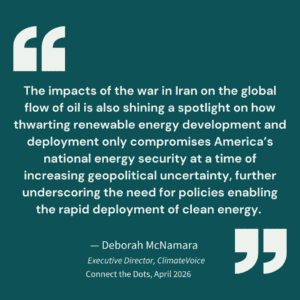
A case in point: dozens of wind farms are being delayed across the country at a time when expedited permitting would solve massive energy security and energy affordability concerns. The delays are “dragging down a race led by tech companies to build power-hungry data centers,” with an estimated 30+ onshore wind farm projects affected (7.5 gigawatts of stalled capacity), which could “produce enough electricity to power several cities — or multiple large data centers.” The impacts of the war in Iran on the global flow of oil is also shining a spotlight on how thwarting renewable energy development and deployment only compromises America’s national energy security at a time of increasing geopolitical uncertainty, further underscoring the need for policies enabling the rapid deployment of clean energy.
Policies to improve transmission planning and modernization are a key example of how states can lead the way, with many states passing advanced transmission and grid enhancing technologies that improve the capacity of existing electrical transmission and distribution systems. Legislation to accelerate community solar programs continues and ‘plug-in solar’ bills are on the rise across the country, which I’ll dig into more below.
And when it comes to electric vehicles, though federal policy eliminated consumer tax credits for electric vehicles and paused EV charging infrastructure funding, states are continuing to power the U.S. electric vehicle transition. In 2026, state level policies that expand EV incentives and tax credits and build out charging infrastructure and grid preparedness will be critical. A key advocacy opportunity is in California, where the state is pushing ahead on EV mandates, launching a $200 million electric vehicle incentive program meant to offset federal EV tax credit losses.
On the corporate political advocacy side in the U.S., automakers such as General Motors lobbied against their own EV goals, which unfortunately helped overturn federal and state-level rules on vehicle emissions and fuel efficiency. GM had pledged to shift to an all-EV lineup by 2035 and their corporate leadership in this space is essential going forward. Honda and Ford both argued for retaining the overarching rules even while pushing back against the specifics of the regulations. More specifically, Ford noted that eliminating the standards altogether would “undermine the stability the industry needs to justify long-term investment in new vehicles.”
While the U.S. cedes ground to other countries in the EV and clean energy transition and doubles down on fossil fuel dependence, globally renewable energy produced more electricity than coal for the first time in 2025, and the International Energy Agency (IEA) forecasts that global electric vehicle adoption will continue to accelerate.
The Nitty Gritty
We’ll use this section to wade deeper into top news in the climate world.
State Level Policies to Democratize Clean Energy Access Are Gaining Momentum
At a time when federal climate and clean energy policies are moving us in the wrong direction on clean energy access, energy security and energy affordability, state-level advocacy is more important than ever. Solar is now the cheapest source of energy, but millions of Americans don’t have access to this renewable resource. Policies to expand access to clean energy have the potential to address the climate crisis at scale, reducing pollution and greenhouse gas emissions while also tackling the affordability crisis and promoting energy security.
One literal bright spot in 2026 is the momentum of the growing ‘plug-in solar’ movement (also known as balcony solar). In 2025, Utah passed a first-of-its-kind bipartisan bill to enable plug-in solar units, which are small, affordable panels that anyone with outdoor space can plug-in and use to generate electricity. 30+ states are following Utah’s lead this year by introducing bills in this legislative cycle, providing an important bipartisan opportunity that will address energy affordability concerns, while also expanding clean energy access. In March, Virginia became the second state to allow plug-in or balcony solar, passed with a unanimous bipartisan vote – and in early April, Maine joined as the third state to pass similar legislation.
Hot off the press is ClimateVoice’s newest resource – an issue and action policy brief explaining why plug-in solar is an innovative state policy worth supporting.
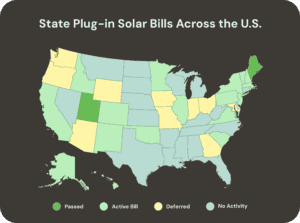
State data provided by Bright Saver. Current as of 4/8/2026.
Plug-in solar has the potential to expand access to renewable energy to 60 million Americans, and passing related legislation in even five states has the potential to create a multiplier effect where consumer demand increases the supply of these panels, drives down costs, and makes solar energy more mainstream. Employees, sustainability professionals and business leaders can elevate this climate policy advocacy opportunity at work — and urge your sustainability and/or government relations teams to weigh in with public support at the state level, everywhere your company operates. We invite you to raise the visibility of this climate solution inside your company and in your communities to spark a movement for energy that is abundant, affordable, and clean.
For a Deeper Dive
When it Comes to AI + Data Center Policies, Clean Energy and Environmental Guardrails Should Be Front and Center
AI and data center buildouts continue to be an additional priority state-level policy issue to engage in this year. With mounting public pushback and corporate climate targets increasingly at risk, clean energy powered AI and data centers is more crucial than ever. Policies at the state and federal level should address massive energy and water consumption, the pitfalls of fossil fuel overreliance, straining local resources along with increased harmful greenhouse gas emissions and hazardous electronic waste.
Clean energy investments need to scale to mitigate the demands of AI and data center expansion. This has the potential to reduce emissions and lower the market costs of energy. Robust environmental standards (especially per water and energy usage and impacts) should be a high priority — along with addressing community, environmental justice and public health impacts.
A growing number of states are advancing legislation focused on data centers, with at least six states calling for a pause in data center construction. (Maine is now positioned to become the first state to ban new data centers). A Colorado bill released in February aims to ensure data centers pay for grid investments, requiring renewable energy for new data centers to guard against rising energy bills. Virginia, home to one of the world’s largest concentrations of data centers, has dozens of bills underway, with the data center building boom stirring pushback from local communities. And in Illinois, the current “Power Act” urges a “Bring Your Own Clean Energy” (or BYOCE) approach, offering perks and prioritization for data centers that invest in clean energy while protecting water and ratepayers.
As these state-level policies continue to accelerate coupled with increased pushback at the community level, environmental guardrails should be front and center, along with a ‘humans first’ approach, especially given that AI adoption threatens the loss of millions of jobs, with recent estimates from Goldman Sachs suggesting 6-7% of U.S. workers could lose their jobs as a result of accelerated AI adoption. With the absence of government leadership on climate-related policies at the national level, there’s even more of an imperative for employees, sustainability professionals and business leaders to act.
Coming soon...
Stay tuned for our next issue where we’ll continue digging into corporate climate policy advocacy and how companies and employees can raise the bar on what corporate climate leadership looks like, especially during these uncertain times.
Have a specific question about Corporate Political Responsibility that you’d like us to address? Shoot your questions to us with subject line "Connect the Dots."
Have a specific question about Corporate Political Responsibility that you’d like us to address? Shoot your questions to us with subject line "Connect the Dots."